Where hidden dynamics become leadership risk.
HRDA is useful when the official explanation no longer explains the lived reality.
The message is clear — but behaviour does not change. The structure is defined — but influence flows elsewhere. The policy exists — but workarounds run the system. The culture looks aligned — but people have stopped speaking.
These are not soft signals. They are organisational signals. HRDA helps leaders see them earlier.
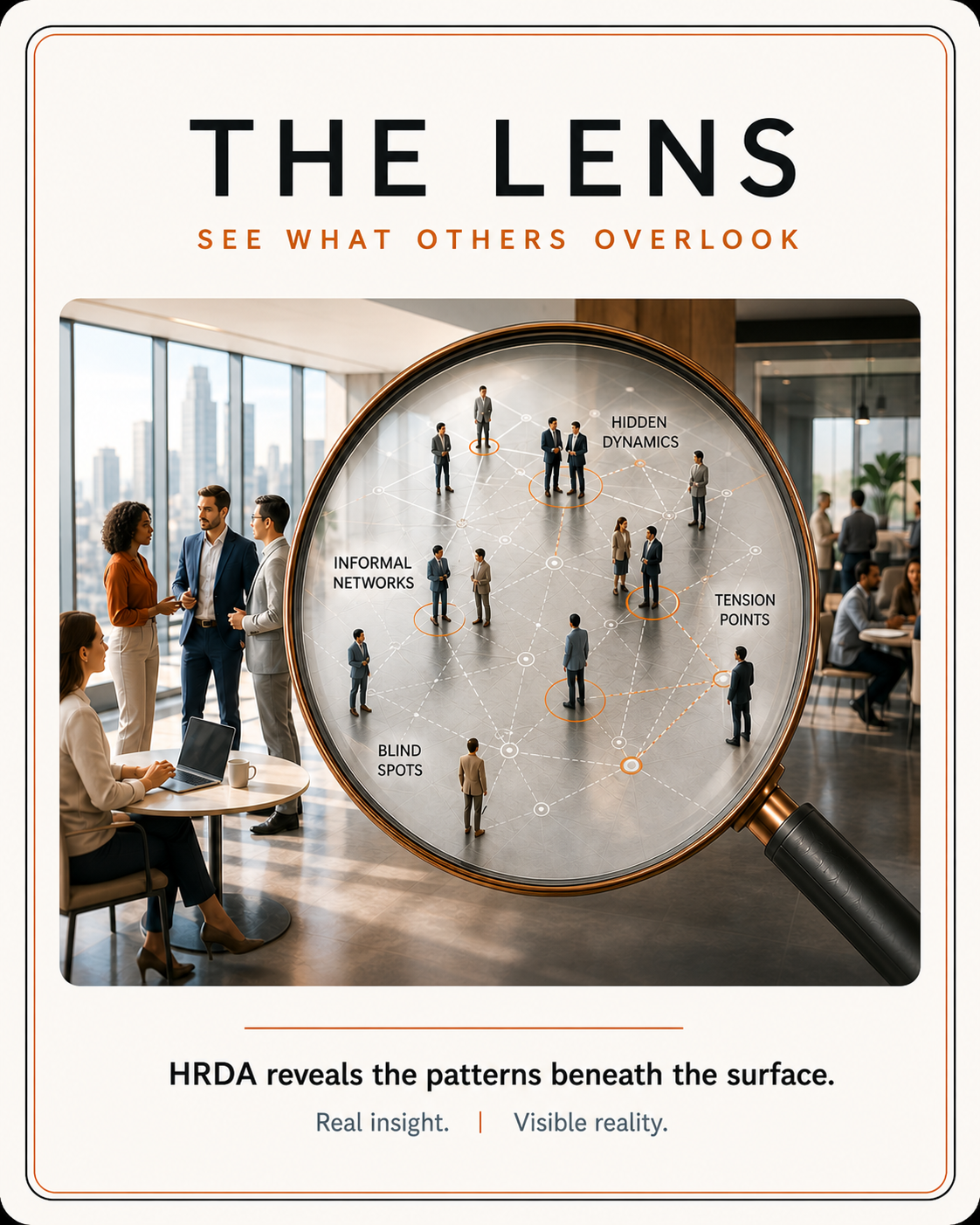
Some organisational problems do not announce themselves as failures. They appear first as patterns.
HRDA is designed for situations where leaders sense that something important is shaping behaviour, trust, execution or risk — but the available data, reports or governance structures do not fully explain it.
The message is clear. Behaviour does not change.
Leadership communicates direction, but the organisation responds with hesitation, reinterpretation or passive delay.
The structure is defined. Influence flows elsewhere.
Formal roles exist, but real decisions are shaped by informal networks, power centres or trusted intermediaries.
The policy exists. Workarounds run the system.
Governance is documented, but daily behaviour follows practical shortcuts, informal exceptions or unspoken rules.
The culture looks aligned. People have stopped speaking.
Surface harmony hides withdrawal, caution, mistrust or fear of consequences.
The transformation is launched. Reality does not move.
Change progresses in plans and slides, but lived incentives, habits and relationships keep the organisation in place.
The risk is not visible yet. The signals are already there.
Human and organisational risk often emerges before formal incidents, complaints or metrics reveal the problem.

Your leadership message is clear. Your organisation may still be hearing something else.
Leadership teams often assume that clarity has been achieved once a message has been communicated. But organisations do not only react to words. They react to credibility, timing, incentives, history, trust and informal interpretation.
HRDA helps identify where leadership intent is being reinterpreted, diluted, resisted or quietly ignored.
- misalignment between message and behaviour
- informal interpretation of leadership signals
- credibility gaps
- hidden resistance
- incentives that contradict the message
- trust conditions that shape reception
When people stop speaking up, silence becomes a management blind spot.
Silence can look like stability. It can also mean that people have stopped believing that speaking up is useful, safe or worth the cost.
HRDA helps distinguish between healthy calm and organisational withdrawal. It makes visible where people comply outwardly but disengage internally.
- quiet disengagement
- self-protection behaviours
- fear of consequences
- reduced initiative
- loss of informal feedback
- blind spots in leadership perception
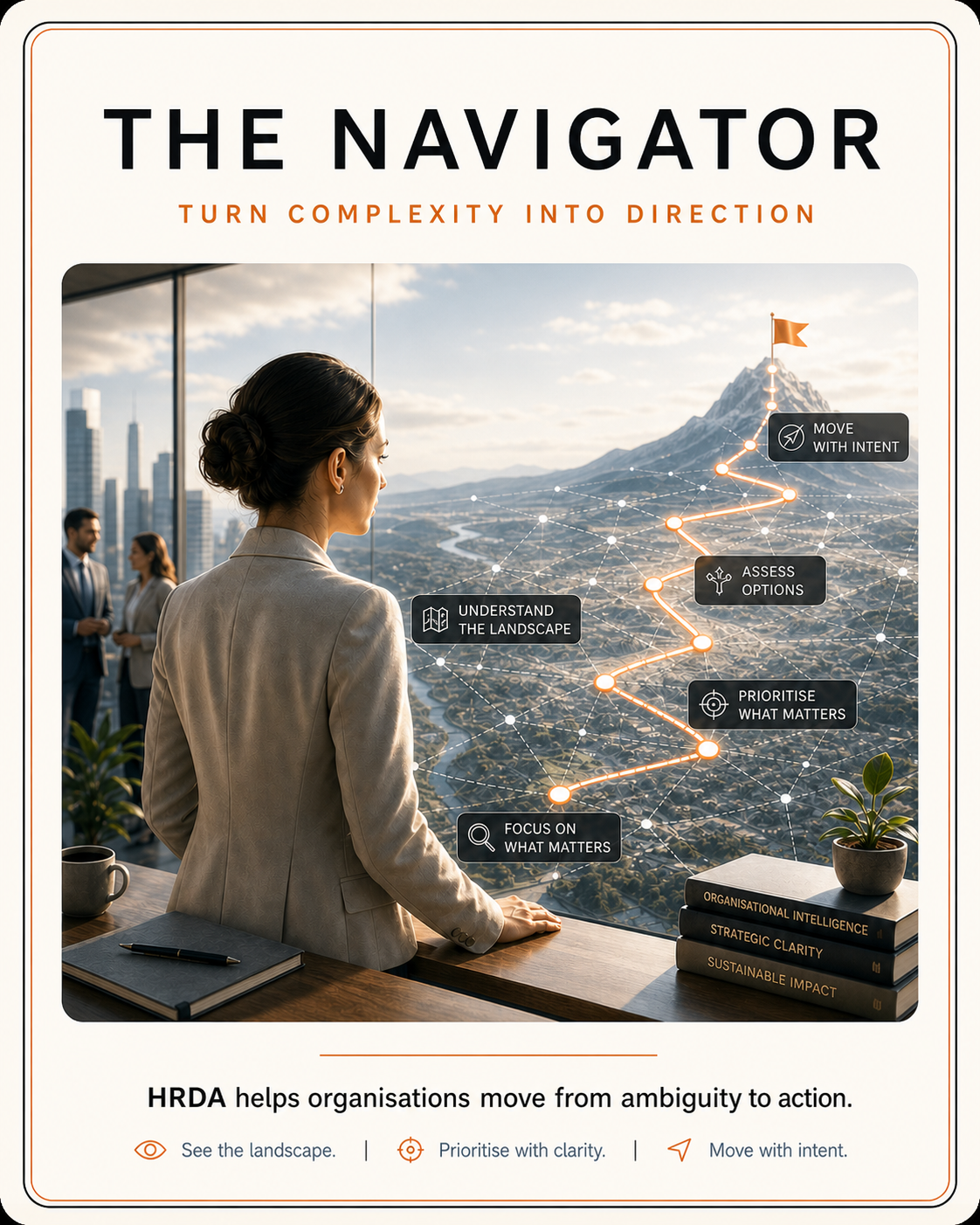
Change does not fail only because of strategy. It fails where lived reality refuses to move.
Transformation can be well designed and still stall. The formal plan may be sound, but the organisation may be shaped by old incentives, informal loyalties, unclear consequences or exhaustion.
HRDA helps identify the lived dynamics that block execution beneath the programme structure.
- silent resistance
- change fatigue
- informal power structures
- conflicting incentives
- workarounds that preserve the old system
- loss of trust in transformation narratives
HRDA applies where human dynamics shape execution, risk and trust.
The following use cases are not isolated HR topics. They affect leadership quality, organisational resilience, risk exposure and the ability to execute.
Governance gaps
Policy describes control. Behaviour reveals whether control exists.
HRDA helps identify where governance is formally present but behaviourally weak.
Trust erosion
Trust rarely collapses overnight. It withdraws quietly first.
HRDA helps detect the patterns that show confidence, openness and cooperation are weakening.
Human risk
Human risk does not start with an incident. It starts with tolerated dynamics.
HRDA makes visible where pressure, silence, avoidance or informal behaviour create risk exposure.
High-growth complexity
Fast growth does not only scale success. It scales hidden friction.
HRDA helps growing organisations understand where speed, ambition and structure create unintended human dynamics.
Restructuring and uncertainty
Uncertainty changes behaviour before the new structure arrives.
HRDA helps reveal how loyalty, fear, influence and informal alliances shift during restructuring.
Security and compliance culture
Controls fail where behaviour learns to bypass them.
HRDA helps connect formal controls with the lived behaviours that determine whether they actually work.
From abstract concern to visible organisational insight.
HRDA can translate weak signals into structured views: dynamics maps, reality gaps, risk patterns, leadership blind spots and next questions for executive sensemaking.
Prototype views can be used to illustrate how organisational signals become visible. Actual outputs are adapted to the context and sensitivity of the organisation.
Dynamics map
Where do tension, influence, withdrawal or trust patterns appear?
Reality gap view
Where does official intent diverge from lived experience?
Executive questions
Which issues require leadership attention before action is taken?
Better visibility creates better judgement.
HRDA does not claim to remove complexity. It helps leaders see which part of the complexity matters.
- What is happening that our formal reporting does not explain?
- Where are people adapting around the system instead of working through it?
- Which dynamics are shaping trust, silence or resistance?
- Where does our official story differ from lived reality?
- What risks are emerging before they become incidents?
- Where is leadership visibility weakest?
- Which conversations are being avoided?
- What should we explore before launching another intervention?
Most use cases start with a Reality Scan.
The Reality Scan is a focused entry format for exploring whether HRDA can clarify the dynamics shaping a specific organisational situation.
It is useful when the issue is important enough to examine, but not yet clear enough to turn into a predefined intervention.
Use cases keep HRDA grounded in real organisational problems.
Project HRDA develops Organisational Reality Intelligence through concrete organisational situations rather than abstract theory.
For organisations, the Reality Scan is the practical entry point. For selected partners, domain experts, builders and investors, Project HRDA opens the broader conversation about how this capability can be tested, challenged and shaped.
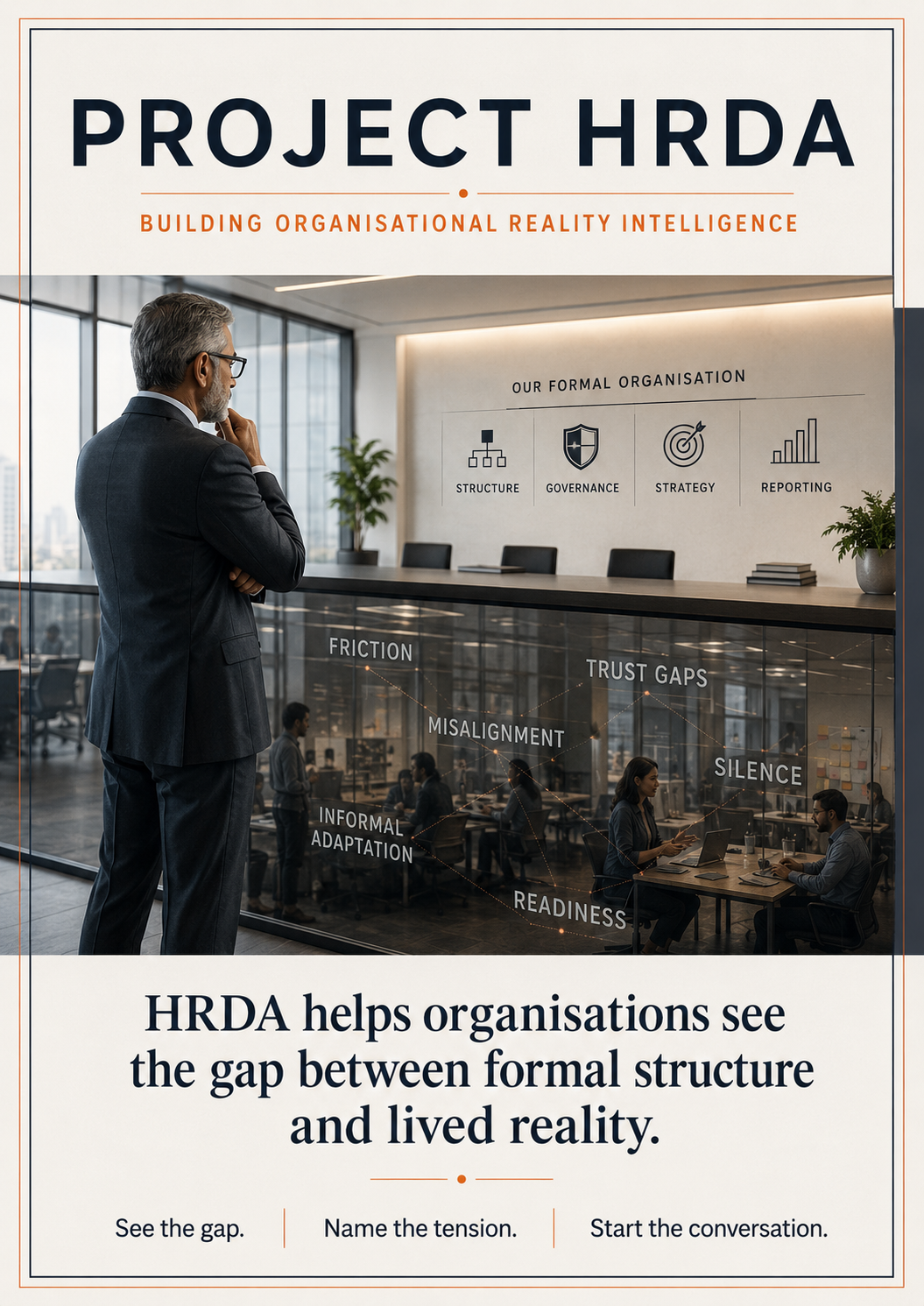
If the symptoms are visible but the dynamics are not, HRDA can change the conversation.
Use Cases show where HRDA applies. A Reality Scan helps clarify whether it applies to your situation.